
Run your browser tests in your own Kubernetes cluster
Moon runs Selenium, Playwright, Cypress and Puppeteer tests in parallel inside your Kubernetes or OpenShift cluster, with 4 sessions free and no licence key.
- Selenium · Playwright · Cypress · Puppeteer
- Kubernetes and OpenShift 4.x
- 4 parallel sessions always free
Built for teams that want control over their test infrastructure
Teams in regulated industries move to Moon when browser tests should run inside their own infrastructure instead of a third-party cloud.
Your data stays in your network
Test data, internal staging environments and credentials never leave your cluster. Moon can even run without Internet access.
Costs you can plan
You pay only for the number of parallel browser sessions, so the price stays predictable as your test suite grows.
No rewrite of your tests
Moon works with Selenium, Playwright, Cypress and Puppeteer, so existing tests usually just point at a new endpoint.
From zero to parallel browsers in three steps
Moon installs into your cluster with Helm and starts a clean browser in its own container for every session.
Install Moon with Helm
Three commands on Kubernetes or OpenShift 4.x. Without a licence key Moon starts with up to 4 parallel sessions.
# add the Aerokube chart repository and install Moon 2
helm repo add aerokube https://charts.aerokube.com/
helm repo update
helm upgrade --install --create-namespace -n moon moon aerokube/moon2Point your tests at Moon
Selenium tests use Moon's WebDriver endpoint on port 4444. For Playwright, Cypress and Puppeteer only the connection URL changes.
Scale with a licence key
Add your licence and run as many parallel sessions as you licence. Kubernetes starts and removes browser pods as the load changes.
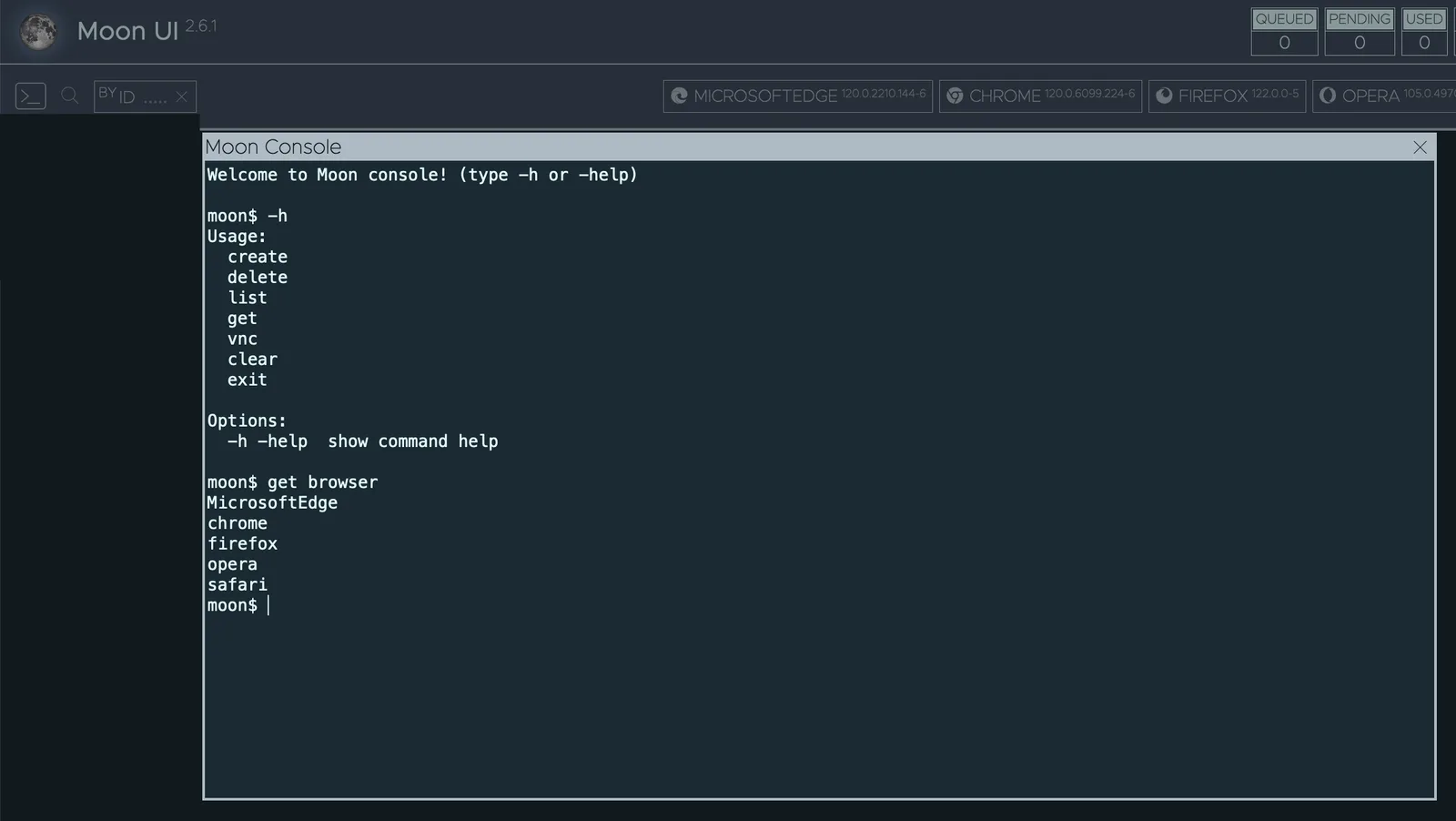
Everything you need to debug a failing test
- Live browser screenWatch any running session in the Moon UI, view-only or take control when you need to step in.
- Video and logsRecord any session to video, follow live logs and send videos and logs to S3-compatible storage.
- The browsers you test onReady-made images for Chrome, Firefox, Microsoft Edge, Opera and WebKit, published for new browser versions.
- Built for several teamsOne namespace per team with Kubernetes quotas, single sign-on through OpenID Connect and browsers that run as non-root.
- Mobile emulationTest mobile web layouts with device emulation in Chrome.
Parallel sessions turn long runs into short ones
An example from Gertzen Digital: the same suite, run one at a time and in parallel on Moon.
Simple pricing per parallel session
You pay for how many browsers run at the same time, not for test runs.
- Packages from 5 parallel sessions
- Popular: 10 or 20 sessions per month
- Selenium, Playwright, Cypress, Puppeteer included
- 12-month licences for larger teams
- One licence shared across team namespaces
- Sized to your parallel demand
Try Moon for 30 days with the number of sessions you need: tell us in the form and we issue a trial licence.
Is Moon the right fit?
Moon is browser infrastructure you run yourself. Here is when that works well.
A good fit if
- You run Kubernetes or OpenShift, in the cloud or on premises, or you plan to.
- You have automated Selenium, Playwright, Cypress or Puppeteer tests that run regularly, for example in CI/CD.
- You need 10 or more parallel browser sessions, or you are growing towards that.
- Test data must stay in your network, or cloud testing costs keep rising.
Not the right tool if
- You want a hosted service to sign up for, without running a cluster.
- You need real mobile devices or native iOS and Android app testing.
- You need real Safari on macOS or iOS. Moon provides WebKit browser images on Linux.
- You test manually only and have no automated browser tests.
See the Moon UI in action
A short walkthrough of the Moon user interface: running sessions, the live browser screen and manual sessions.
Request a 30-day trial licenceWhat you need to run Moon
- PlatformKubernetes or OpenShift 4.x, installed with Helm 3.
- WherePublic cloud, a private cluster on virtual machines or your own hardware.
- ResourcesAbout 1 CPU and 2 GB RAM per browser by default, so 20 parallel sessions need roughly 20 CPU and 40 GB RAM plus headroom.
- To evaluateA small cluster with at least 4 CPUs and 8 GB RAM is enough.
- OptionalS3-compatible storage for videos and network capture, an Ingress with TLS and authentication.
- Access controlMoon 2 has no built-in login: use your Ingress or the OpenID Connect sidecar that comes with Moon.
Questions teams ask before a trial
Do we have to rewrite our tests?
Usually not. Moon works with Selenium, Playwright, Cypress and Puppeteer. Selenium tests point at Moon's WebDriver endpoint, the other frameworks change their connection URL.
How does the trial work?
Send the form with the number of parallel sessions you need. We issue a 30-day trial licence and send the key to your e-mail. Up to 4 parallel sessions work without any key.
Does Moon support real mobile devices or Safari?
No. Moon runs desktop browsers in containers. Mobile emulation is available in Chrome, and Safari is covered by WebKit images on Linux, not real Safari on macOS or iOS.
Can Moon run without Internet access?
Yes. Moon runs inside your own cluster and can work in closed networks, which is why teams in regulated industries choose it.
How is Moon priced?
$5 per parallel session per month. Up to 4 sessions are always free, paid packages start at 5 sessions, and larger teams often take 50 to 100 sessions on a 12-month licence.
Who is Gertzen Digital Solutions?
We are Aerokube's official partner in Europe and the USA, based in Berlin. We issue Moon licences and help you through your trial.
Try Moon in your own cluster for 30 days
Tell us a little about your setup and we send you a trial licence for the number of parallel sessions you need.
- Send the form, it takes under a minute.
- We send your trial licence key to your e-mail.
- Install Moon with Helm and run your tests in parallel.